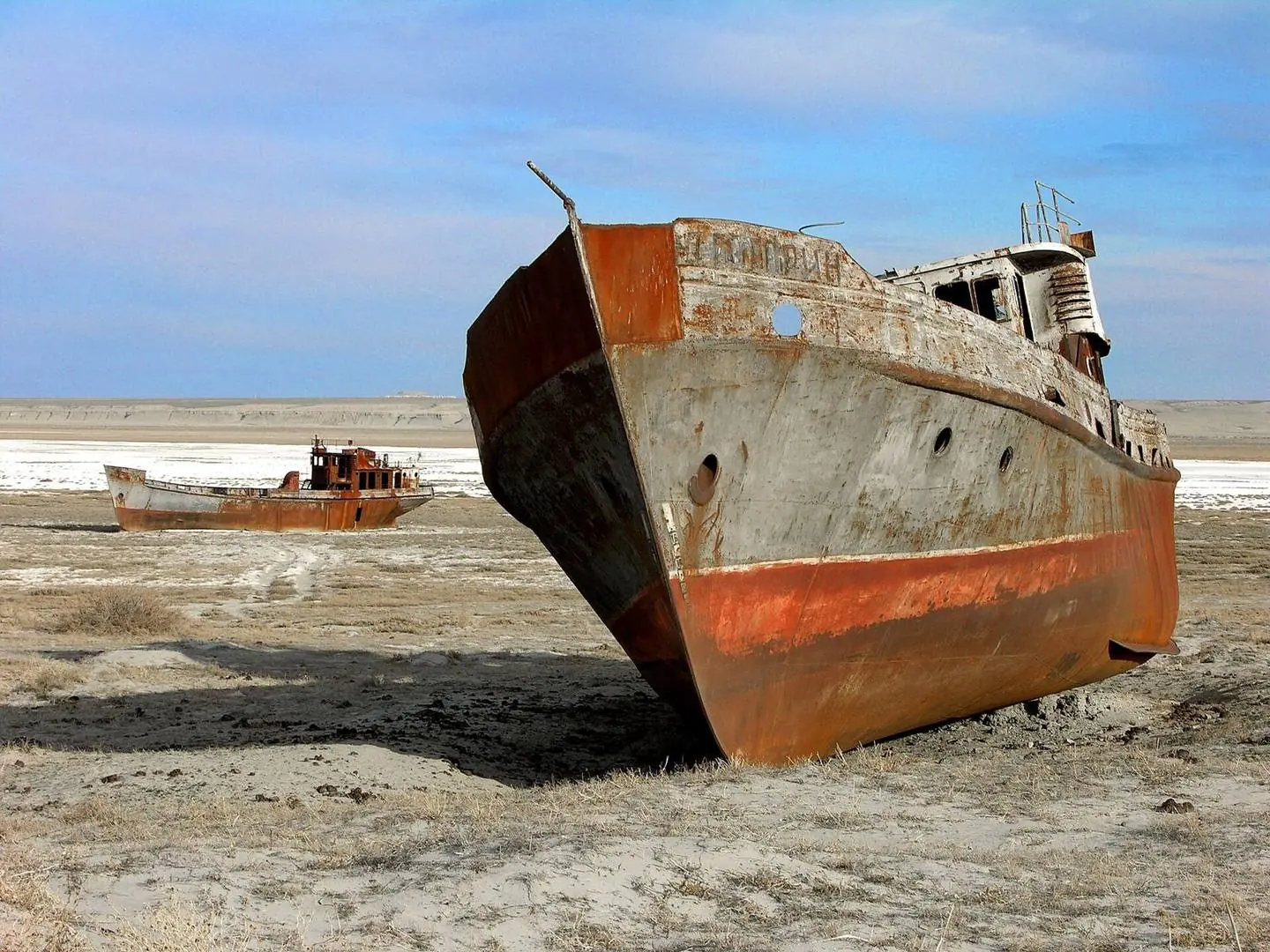
How a sea disappeared
The Aral was once the fourth-largest lake on Earth. From the 1960s, Soviet irrigation projects diverted the Amu Darya and the Syr Darya, the two rivers that fed it. Within a few decades the sea shrank to about a quarter of its size and split in two: the Big Aral in the south and the Small, or North, Aral on the Kazakh side.
Aralsk, once a port town, was left about 40 km from the water. The ships stayed where the sea left them.
And how part of it came back
In 2005 Kazakhstan finished the Kokaral dam, 13 km long, built with World Bank support. It holds the water of the Syr Darya in the North Aral. The sea began to recover within months, and fish came back.
For a filmmaker it is a story with two sides: a dead seabed with its ships, and a sea that returned.
What you can film
- Rusty hulls on the seabed — the image the whole world knows from films about ecological disaster.
- The former seabed to the horizon — flat, cracked and empty: an alien world or the day after the end of the world.
- Aralsk — a port town without a sea.
It suits post-apocalypse, drama, documentary and music videos. The location is in our database: the location fee is zero for our clients, and we handle the permits.
Getting there
- Route: flight from Almaty to Kyzylorda, then by car.
- Crew stays: hotels in Aralsk.
- Best season: May–June and August–September.
- Permits: we arrange them, 14 days.
- Drones: in tourist zones, after registration.
Plan it as its own block
The Aral is not a day trip from Almaty. Put it in the schedule as a separate block: the unit base, gear, catering and transport move to Aralsk, so the camera rolls on the first morning, not after a day on the road.
Within the same western trip you can add Turkestan for the Silk Road and Bozzhyra and Ustyurt for another planet. Mangystau is where Armour of God: Ultimatum with Jackie Chan was filmed (2026). More doubles are in what Kazakhstan can play on screen.